CLIENT EDUCATION · eLEARNING SOLUTION
Helping Texas Couples Navigate the Marriage License Process
| Role | Instructional Designer & eLearning Developer |
| Audience | Engaged couples preparing to obtain a Texas marriage license |
| Tools | Articulate Rise 360 · Canva · Research & Content Development |
| Timeline | 2025 |
| Project Type | Client Education eLearning Solution |
Project Overview
Simplifying the Texas Marriage License Process Through eLearning
Problem
A wedding officiant company needed a consistent and scalable way to help couples understand the Texas marriage license process. Clients frequently had questions about eligibility requirements, documentation, waiting periods, and county-specific procedures, requiring significant one-on-one support and repeated explanations.
Solution
I designed and developed a self-paced eLearning course in Articulate Rise 360 that provided couples with clear, step-by-step guidance on obtaining a Texas marriage license. The course consolidated essential information into a single learning experience, reducing confusion, supporting independent decision-making, and improving client readiness prior to wedding services.
Learner Analysis
Learner Profile
The primary learners were engaged couples seeking information about obtaining a Texas marriage license. Learners varied in age, educational background, and familiarity with county government processes. Many were navigating the marriage license process for the first time and required clear, accessible guidance.
Learner Needs
Interviews with the client and review of frequently asked questions revealed that couples often struggled to locate accurate information regarding eligibility requirements, required documentation, waiting periods, fees, and county-specific procedures. Learners needed a centralized resource that simplified the process and reduced uncertainty.
Prior Knowledge
Most learners possessed basic internet navigation skills but had limited knowledge of Texas marriage license requirements. Learners frequently relied on multiple websites and informal sources, which sometimes resulted in confusion or misinformation.
Design
Learner Objectives
Upon completion of the course, learners will be able to:
- Identify eligibility requirements for obtaining a Texas marriage license
- Determine required documentation and application procedures
- Explain waiting periods and legal requirements
- Locate county-specific resources and application information
- Complete the marriage license application process with confidence
Design Decisions
The course was designed using a learner-centered approach that emphasized simplicity, accessibility, and immediate application. Because learners were seeking information to complete a real-world task, content was organized into short, focused modules that mirrored the actual steps couples follow when obtaining a marriage license. Information was presented in a logical sequence to reduce cognitive load and support self-directed learning.
Instructional Strategies
The learning experience incorporated:
- Scenario-based examples
- Knowledge checks
- Interactive navigation
- Visual job aids
- Real-world application activities
Course Structure
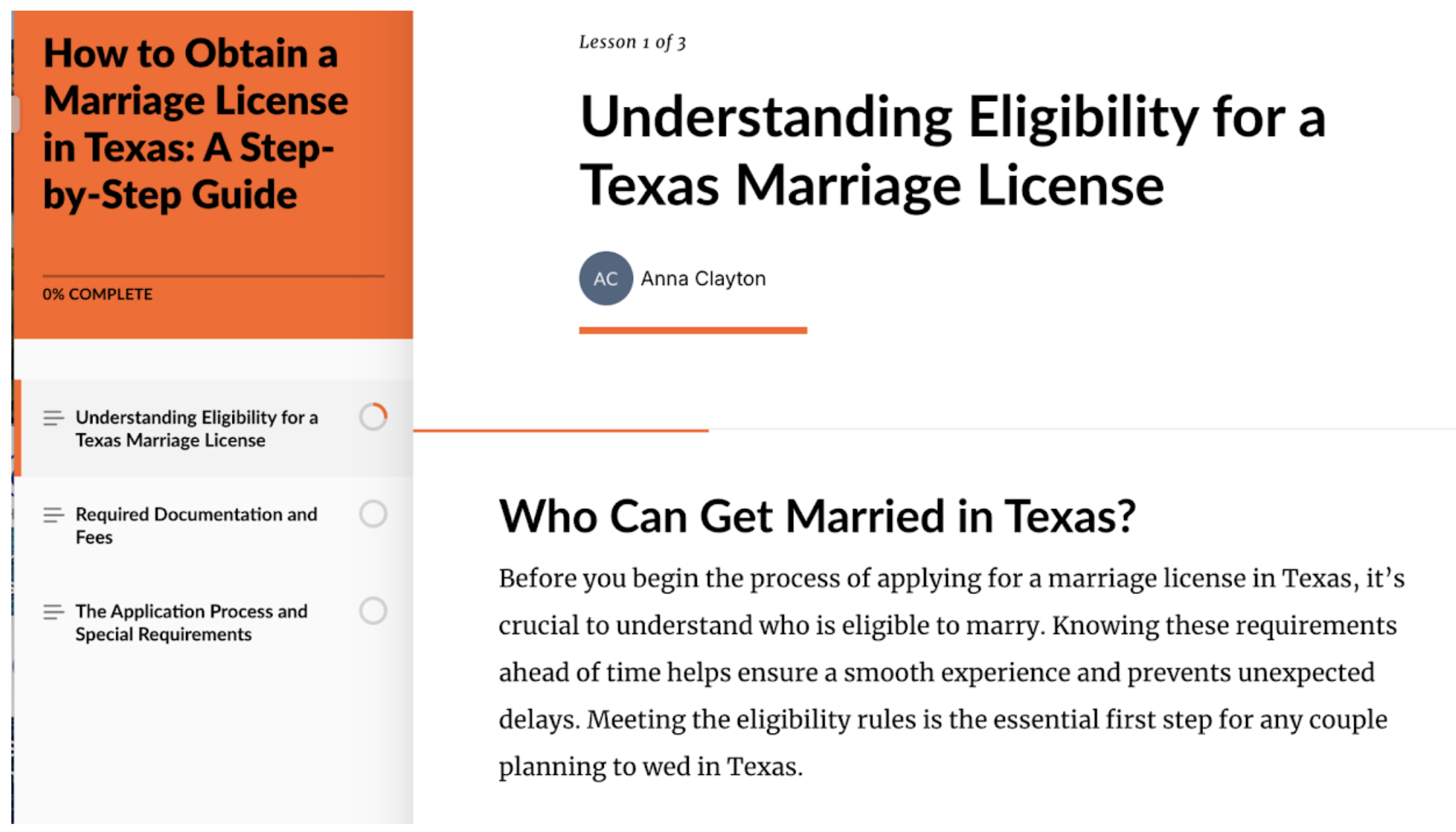
- Introduction to Texas Marriage Licenses
- Eligibility Requirements
- Required Documentation
- Fees and Waiting Periods
- County-Specific Resources
- Frequently Asked Questions
- Next Steps and Resources
Design Rationale
Articulate Rise 360 was selected because it provided a mobile-friendly, accessible learning environment that allowed learners to access information at their own pace. The platform supported interactive content, streamlined navigation, and responsive design, ensuring a consistent experience across devices.
Development & Prototype
I developed a self-paced eLearning experience in Articulate Rise 360 using interactive tabs, checklists, structured content, and guided navigation to help couples understand and complete the Texas marriage license process. Content was organized into manageable learning segments to reduce cognitive load, improve usability, and support independent completion of required tasks.


Interactive Course Prototype
Launch the pilot version of the course below.
Launch the Course →Evaluation
Alpha Test
The prototype was reviewed by the client to assess accuracy, usability, navigation, and alignment with learner needs. Feedback informed refinements to content organization, instructional flow, and clarity of guidance.
Prototype Validation
The pilot course was tested to verify navigation, content accuracy, functionality, and learner accessibility prior to implementation.
Results
- Consolidated complex marriage license requirements into a single learning resource
- Reduced repetitive client questions and support requests
- Improved access to accurate information before consultations
- Created a scalable onboarding resource for prospective wedding clients
Impact
The course transformed a repetitive support process into a scalable self-service learning solution. By providing clear guidance before consultations, the learning experience improved client readiness, reduced support demands, and allowed staff to focus on higher-value client interactions.
Competencies Demonstrated
- Learner Analysis
- Learning Objectives Development
- Instructional Design
- UX Design
- eLearning Development
- Formative Evaluation
My Contributions
- Conducted learner and content analysis to identify information gaps and support needs
- Defined learning objectives and designed the course architecture
- Organized complex regulatory information into a clear, learner-centered experience
- Designed navigation, user experience, and interactive learning activities
- Developed course content, visual assets, and performance support resources
- Built, tested, and published the course in Articulate Rise 360
- Evaluated usability, accessibility, and learner experience to improve effectiveness